

Blog
Generator for Banking and Financial Institutions in Hyderabad: Power Without Interruption
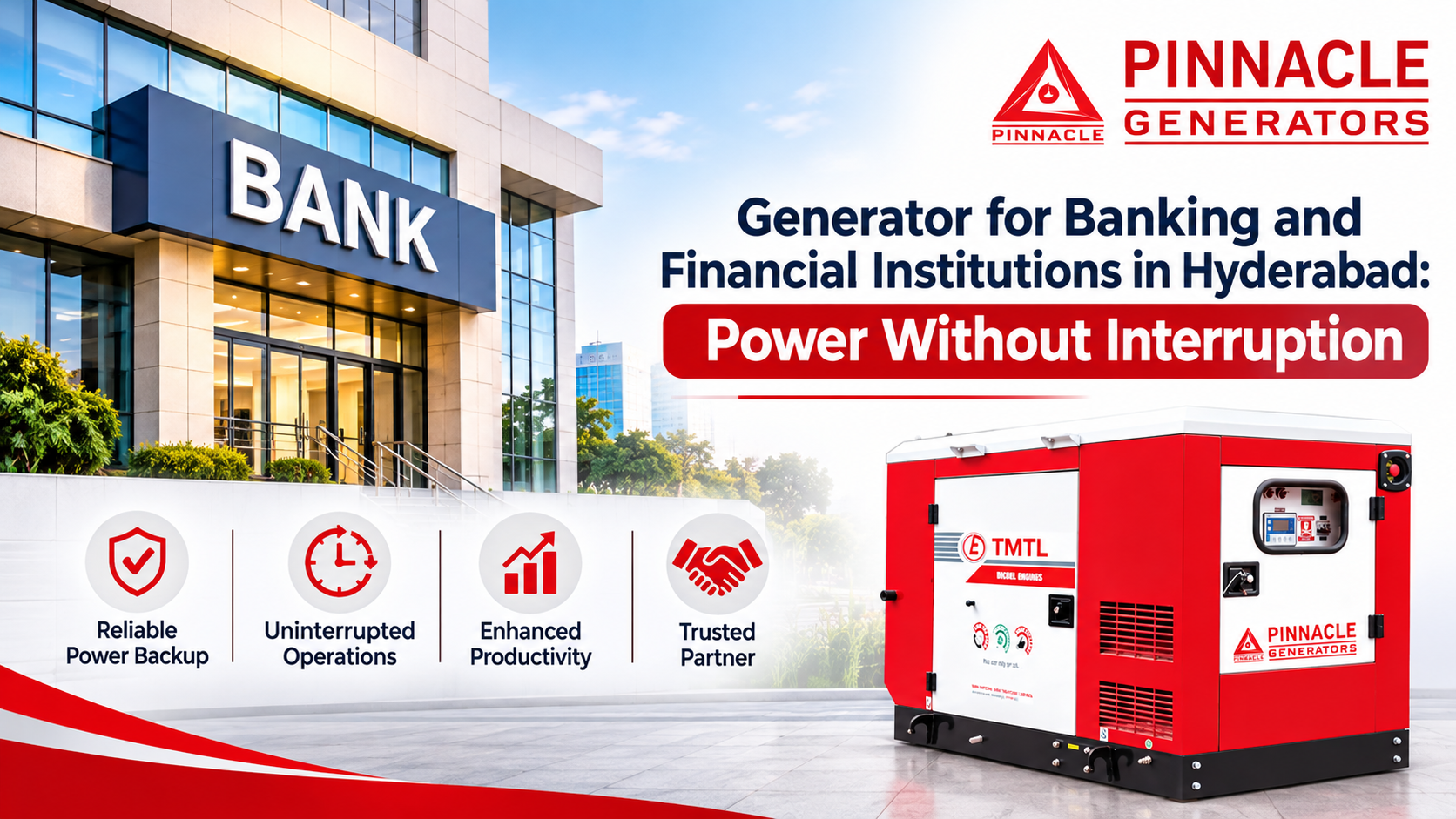
Banking runs on trust, and trust depends on availability. Branches, ATMs, data centres, trading desks and back-office operations in Hyderabad must stay online throughout the day, and in many cases through the night. Even a brief outage can delay transactions, interrupt customer service and create operational risk.
A dependable generator, combined with UPS systems, forms the foundation of power resilience for financial institutions. This guide explains how to plan and select a generator for banks, NBFCs, insurance offices and other financial establishments.
Why Financial Institutions Need Robust Backup Power
Continuity of Transactions
Core banking systems, payment gateways and customer counters rely on continuous power. Interruptions can create reconciliation issues and customer dissatisfaction.
Security Systems
Vaults, alarms, CCTV, access control and ATMs must function at all times to protect assets and people.
Data Protection
Servers and network equipment need protection from abrupt shutdowns that may damage hardware or corrupt data.
Business Reputation
Customers expect financial institutions to be reliable. Consistent service during power failures strengthens confidence.
Power Architecture for Banks
The Role of UPS and Generator Together
A UPS bridges the few seconds between mains failure and generator start-up, and a generator supplies longer-term power. Together they provide seamless protection for sensitive equipment.
Critical and Non-Critical Loads
Servers, networking, security, lighting and part of the air conditioning are usually critical. Less essential loads can be excluded to keep the generator size practical.
Redundancy Planning
For data centres and large offices, redundant gensets or an N+1 configuration help ensure that a single failure does not interrupt operations. The level of redundancy should match your risk tolerance.
Selecting the Right Generator
Correct Capacity
Calculate the combined load, including UPS charging, air conditioning and lighting, and allow a margin for expansion. Professional load analysis is strongly recommended.
Clean and Stable Output
Sensitive electronics need steady voltage and frequency. Choose gensets with quality alternators and responsive engine governors, and check that they work well with your UPS.
Quiet Operation
Branches are often in busy commercial or residential areas. Acoustic enclosures reduce noise and make installation easier to approve.
Compliance
Select CPCB IV+ compliant diesel gensets as applicable, and make sure that the installation follows local safety and fire regulations.
Automatic Controls
AMF panels and remote monitoring ensure that the generator starts, transfers and reports faults without constant manual supervision.
Installation Challenges in Urban Locations
Limited Space
Many bank branches occupy rented premises with little room. Compact canopies, rooftop installations or shared building arrangements may be needed, subject to permissions.
Coordination with Landlords and Authorities
Obtain necessary approvals from building owners or associations, and ensure installation meets electrical and safety standards.
Fuel Storage and Safety
Keep diesel storage limited to safe quantities and follow fire safety rules. Plan refuelling access without disrupting daily operations.
Maintenance and Testing Discipline
Regular Load Tests
Run the generator on load regularly to confirm that it will work during an actual outage. Record the results.
Preventive Servicing
Follow service schedules for oil, filters, coolant, belts and batteries. Early detection prevents surprises.
Service Level Agreements
Choose a supplier who commits to defined response times and can support multiple branches across Hyderabad.
What to Look for in a Supplier
Financial institutions should choose suppliers who understand critical infrastructure, can manage multi-site rollouts and provide reliable documentation. Ask about experience with commercial clients, spare parts availability, escalation processes and the ability to standardise equipment across locations to simplify maintenance.
Frequently Asked Questions
Do ATMs need their own generator?
Standalone ATMs often rely on a UPS and sometimes on a shared building generator. For clusters of ATMs or kiosks, a dedicated or shared set may be justified depending on risk and location.
How much redundancy do branches need?
Most branches manage with a single generator and a UPS, while data centres and regional hubs may need N+1 or more. Your risk assessment and regulatory expectations should guide the choice.
Can the same supplier service all branches?
Many suppliers offer multi-site contracts with standard reporting, which simplifies service and helps keep equipment consistent across branches.
Planning a Multi-Branch Rollout
Standardising capacity classes, panel designs and service contracts across branches saves time and spares. Plan site surveys in advance, prioritise high-risk locations first and document every installation so that future audits and maintenance are straightforward.
Working with Your Facility and IT Teams
Involve facility managers and IT teams from the start. They know which systems are critical, which circuits can be shed and how the UPS is configured, and their input leads to a better electrical design and fewer problems at commissioning.
Conclusion
For banks and financial institutions in Hyderabad, backup power is essential infrastructure. By combining a properly sized, compliant generator with UPS systems, planning redundancy, and committing to disciplined maintenance, institutions can protect transactions, data and customer trust.
Pinnacle Generators works with commercial and institutional customers to design dependable power backup. Contact the team to discuss your branch or office requirements.