Blog
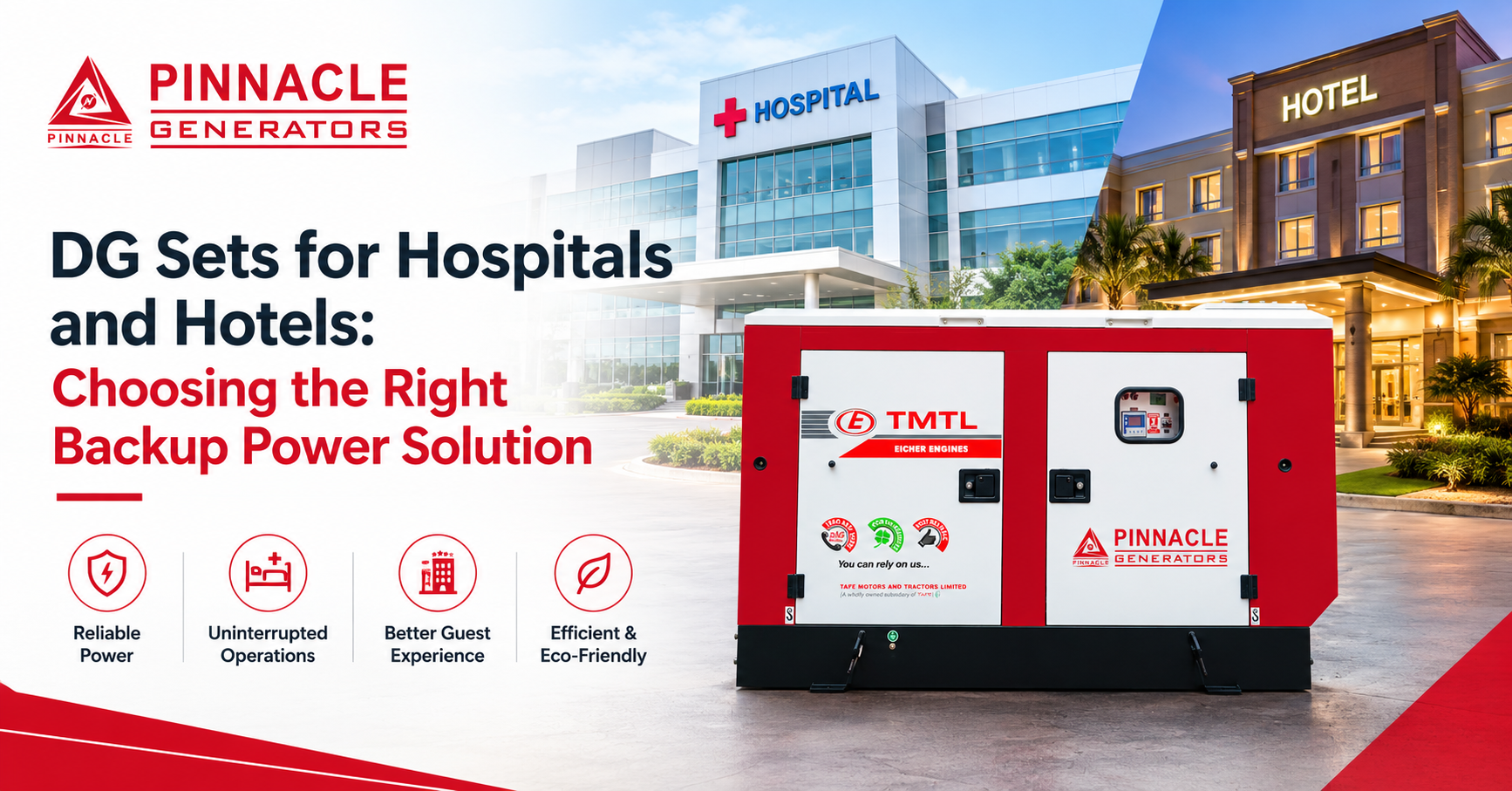
DG Sets for Hospitals and Hotels: Choosing the Right Backup Power Solution
Introduction
Hospitals and hotels are two of the sectors where power interruption is simply not an option. In a hospital, a few seconds of outage can affect life-support equipment, operation theatres, and ICUs. In a hotel, even a short blackout can disrupt guest experience, lifts, and critical building systems. Choosing the right diesel generator (DG) set for these environments requires a different approach than sizing a backup for a typical office or retail space. This guide covers what hospitals and hotels should evaluate before investing in a DG set.
Why Hospitals and Hotels Have Unique Power Needs
Both sectors run a mix of critical and non-critical loads simultaneously. A hospital may need to keep ventilators, monitors, cold storage for medicines, and operation theatre lighting running without interruption, while a hotel needs to maintain lifts, fire safety systems, kitchen equipment, and guest-facing HVAC. This means the DG set must not only provide adequate capacity but also switch over fast enough that sensitive equipment isn’t disrupted.
Key Factors When Choosing a DG Set
- Load assessment: A detailed audit of both critical and non-critical loads is essential to size the generator correctly — undersizing risks overload, while oversizing wastes fuel and capital.
- Automatic transfer switch (ATS) response time: For hospitals in particular, the changeover from mains to generator power should happen within seconds to avoid disrupting medical equipment.
- Noise levels: Hotels especially need acoustically enclosed, silent DG sets so operation doesn’t disturb guests, given proximity to occupied rooms.
- Fuel efficiency and runtime: Extended outages in some regions mean the generator may need to run for several hours; fuel tank capacity and consumption rates should be checked against realistic outage durations.
- Emission compliance: Generators should meet current CPCB emission norms applicable in India, particularly important for hospitals located in dense urban areas.
- Maintenance support: A reliable annual maintenance contract (AMC) and access to spare parts matters more in these settings, where downtime has a direct impact on patient safety or guest satisfaction.
Sizing Considerations Specific to Each Sector
For hospitals, sizing typically needs to account for simultaneous operation of ICU equipment, operation theatres, diagnostic machines (which can have high inrush currents), and building services like lifts and pumps — often requiring a tiered backup approach where the most critical loads get near-instant power. For hotels, sizing usually factors in guest room HVAC, kitchen equipment (which can have significant peak loads), lifts, and life-safety systems, with some properties opting for partial backup during outages and full backup only for critical infrastructure.
Redundancy and Reliability
Given the stakes involved, many hospitals and larger hotel properties choose to install more than one DG set, either for full redundancy (N+1 configuration) or to split critical and non-critical loads across separate units. This approach reduces the risk of a single point of failure taking down power to essential areas.
Conclusion
Selecting a DG set for a hospital or hotel isn’t just about kVA rating — it’s about matching capacity, changeover speed, noise control, and compliance to the specific demands of a 24×7 critical environment. At Pinnacle Generators, we work with healthcare and hospitality facilities to assess their load profile and recommend a backup power solution that keeps essential systems running without compromise. Reach out to our team for a detailed site assessment and sizing recommendation.