

Blog
AMF vs ATS — The Difference Explained Simply
By Pinnacle Generators · Reading Time : 5 min
The power goes out. Your generator starts. But does your load actually switch over? And did anyone have to press a button to make that happen? If you are not sure, you probably do not know which panel you have. That is a problem worth fixing before the next outage.
Two Panels, One Job, Very Different Executions
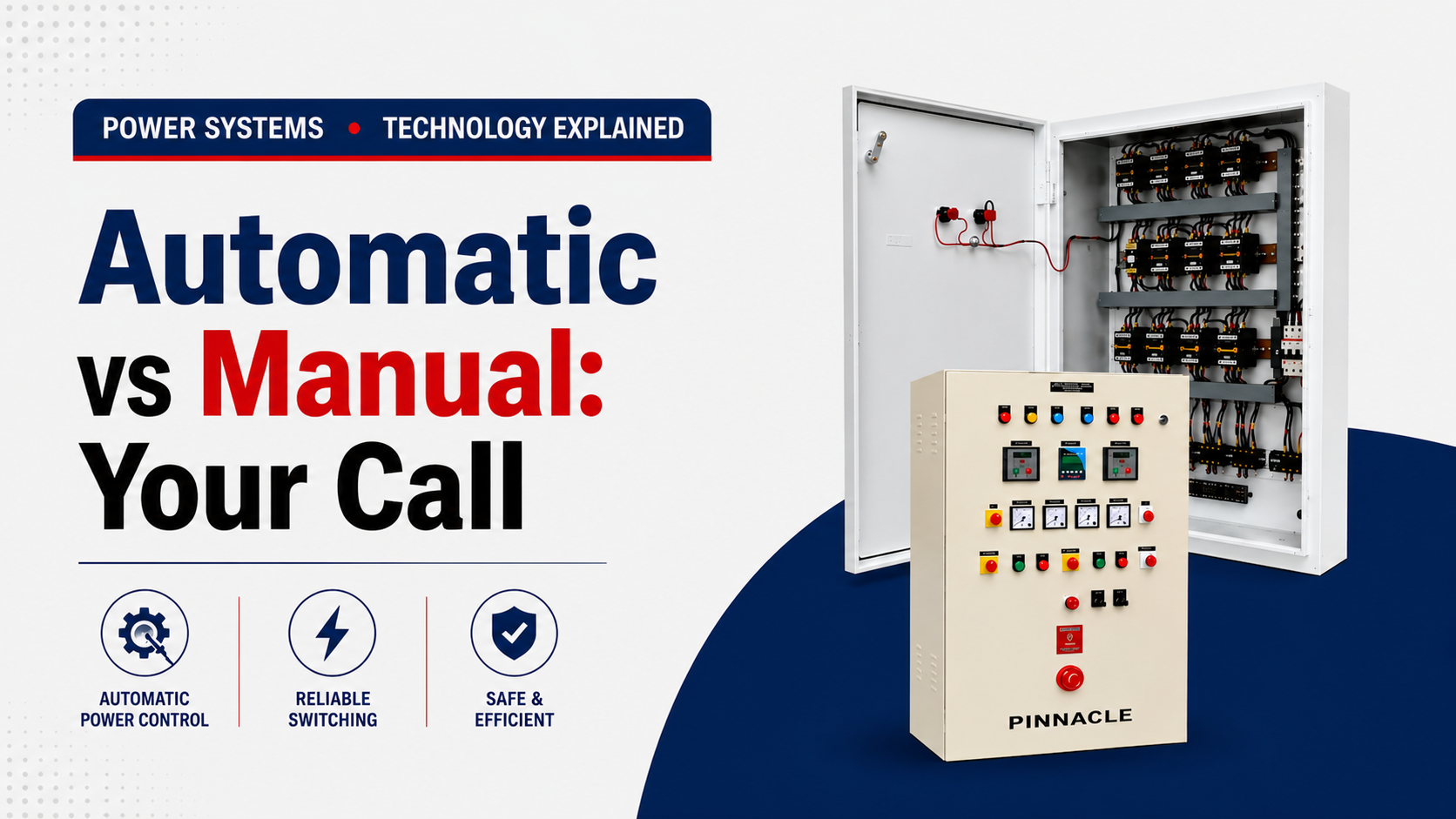
Both AMF and ATS panels exist to do one thing: connect your load to the generator when mains power fails. The difference is in how they do it, how fast, and how much human involvement is required. They are often used interchangeably in conversation. They should not be.
ATS — Automatic Transfer Switch
ATS detects a mains failure and switches the load to an alternate source automatically — but only if that source is already running. The generator still needs to be started manually. Someone has to physically go and crank it.
Benefits: Simpler circuitry, lower cost, reliable transfer when an alternate source is already live, suitable for dual-mains setups.
Cons: Does not start the generator automatically, requires manual intervention, not suitable for unattended or remote sites.
AMF — Automatic Mains Failure
AMF does the full job. Power fails, the panel detects it, sends a start signal to the generator, waits for stable voltage and frequency, transfers the load, and when mains returns, transfers back and shuts the genset down. No human involvement at any step. This is what most people actually imagine when they buy an “automatic generator.”
Benefits: Fully unattended operation, start-to-transfer within 10 to 30 seconds, automatic return to mains, protects the generator from unnecessary run time, ideal for remote sites.
Cons: Higher cost than ATS, requires proper genset compatibility, and periodic testing is non-negotiable — if the panel malfunctions, all automatic protection is lost.
Pinnacle Generators offers AMF panel options across their full range from 5 kVA to 125 kVA, listed as a factory configuration alongside manual control — keeping integration clean and warranty accountability in one place.
Which One Do You Actually Need?
If someone is always present when power fails, and your site has a dual mains supply, ATS may be sufficient. If your generator is the sole backup, the site is unattended for any part of the day, or a few minutes of manual response time is unacceptable — AMF is not optional.
It is the baseline. The cost difference between the two panels is small relative to what a single unmanaged outage costs in lost production or failed equipment. Buy the generator. But make sure the panel matches what your site actually needs.