Blog
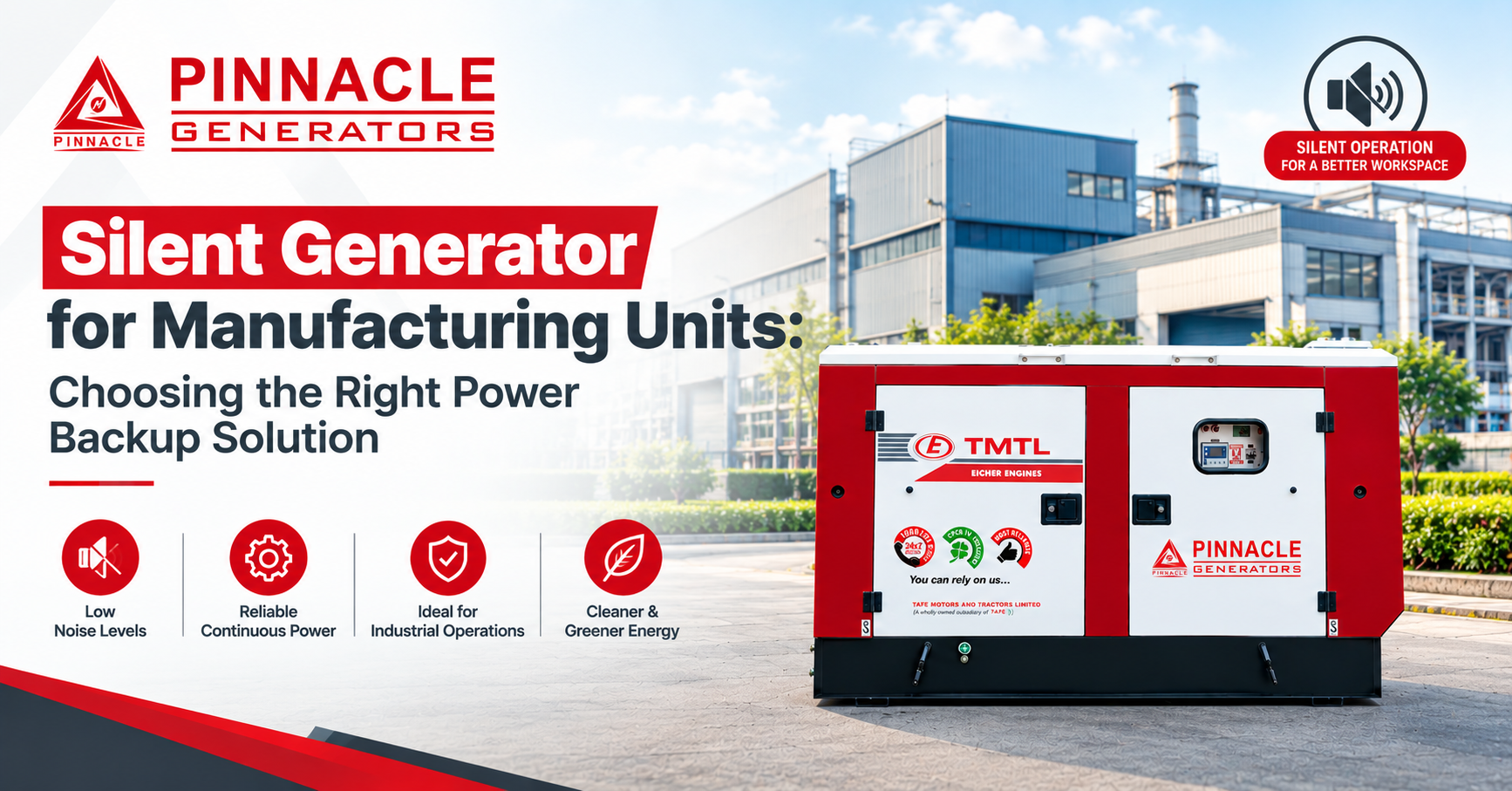
Silent Generator for Manufacturing Units: Choosing the Right Power Backup Solution
Introduction
Manufacturing units operate on tight production schedules where even brief power interruptions can mean stalled machinery, damaged work-in-progress, or missed delivery timelines. At the same time, many manufacturing facilities are located in industrial zones with noise regulations or in proximity to worker housing and other establishments. Silent generators have become the practical choice for balancing these operational and regulatory demands. Here’s how to choose the right one.
Why Manufacturing Units Need Reliable, Silent Backup Power
Production equipment — CNC machines, conveyor systems, compressors, and process-specific machinery — often can’t tolerate power interruptions without risking product defects, equipment faults from abrupt shutdowns, or safety issues. A well-sized silent generator ensures production can continue with minimal disruption during grid outages, while the acoustic enclosure keeps noise levels within limits for worker safety and any applicable pollution control regulations.
Assessing Your Manufacturing Load
- Identify critical production equipment that must stay powered to avoid product loss or safety risks, versus equipment that can tolerate a brief pause.
- Account for high starting currents from motors, compressors, and other inductive loads, which can be several times their running current.
- Consider process continuity requirements — some manufacturing processes (such as certain chemical, food, or plastics processes) can be damaged or wasted by any interruption, requiring near-instant changeover.
- Plan for future capacity — as production lines expand, backup power needs typically grow too, so some sizing headroom is worth building in from the start.
Key Features to Look for in a Silent Generator
- Acoustic enclosure rating suited to your facility’s location and applicable noise limits
- Robust automatic transfer switch for fast, reliable changeover during outages
- CPCB emission compliance appropriate to the generator’s capacity
- Adequate fuel tank capacity for your typical outage duration and production shift patterns
- Easy-access design for routine maintenance without extended equipment downtime
- Availability of local service support given the operational cost of unplanned downtime in a manufacturing setting
Single Unit vs. Parallel Configuration for Larger Facilities
Larger manufacturing units often benefit from a parallel generator configuration rather than a single large unit — this allows the facility to run only as many gensets as needed for the current load, improves fuel efficiency at partial loads, and provides redundancy so that servicing one unit doesn’t take down backup power entirely. Smaller units or single-shift operations may find a single well-sized generator sufficient and more cost-effective.
Conclusion
For manufacturing units, the right silent generator is one that’s sized accurately for production-critical loads, compliant with noise and emission regulations, and backed by dependable maintenance support. At Pinnacle Generators, we work with manufacturing clients to assess their production load and recommend a silent power backup solution built for their specific operations. Get in touch with our team for a facility assessment and sizing recommendation.